
In recent years, the monitoring of coral reef health has made significant progress, particularly thanks to the adoption of new non-invasive techniques. These approaches are essential, as they allow scientists to study extremely delicate ecosystems without damaging or stressing the organisms that inhabit them. Among the most widely used methods today are optical techniques, which range from direct underwater data collection, carried out by scuba divers or robotic systems, to satellite-based remote sensing. Within this context, one technology in particular is gaining increasing attention: underwater photogrammetry.
What is underwater photogrammetry?
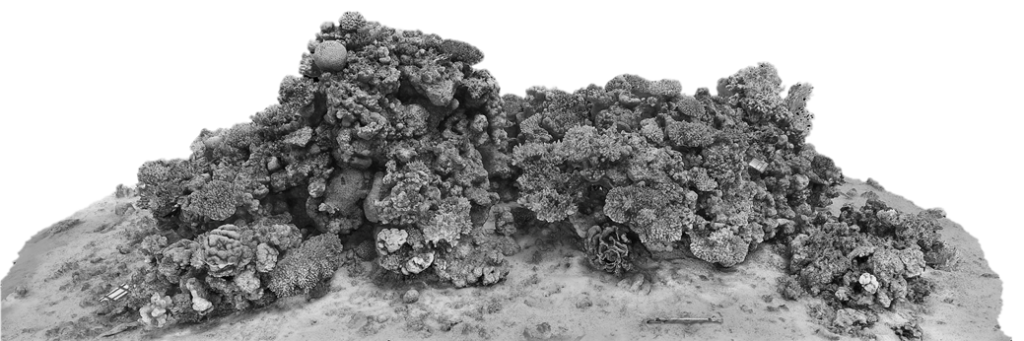
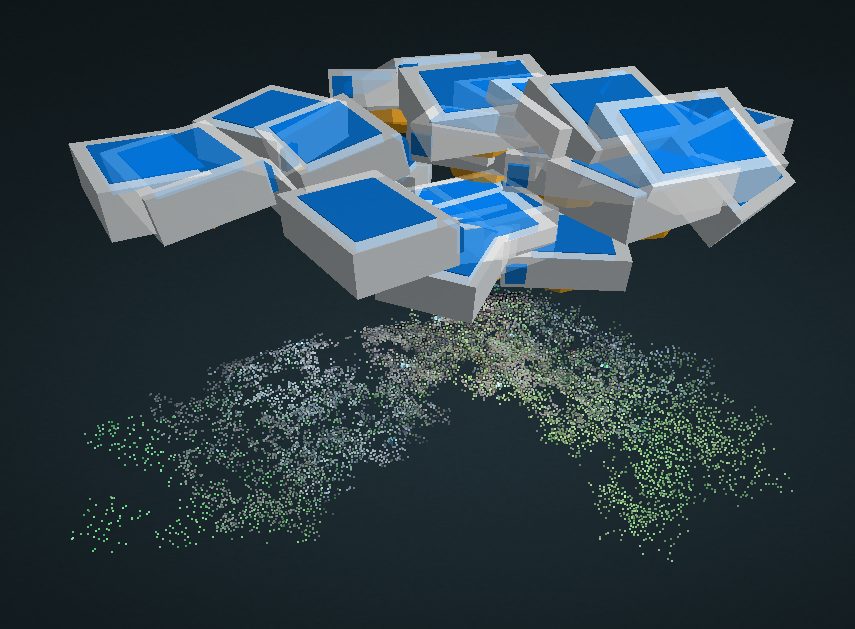
In simple terms, photogrammetry enables the digital reconstruction of a three-dimensional environment from a series of overlapping images. One of the most commonly used approaches is Structure-from-Motion (SfM), which allows researchers to generate detailed 3D models of the seafloor in a relatively cost-effective and efficient way. Underwater photogrammetry involves SCUBA divers moving along the seafloor, taking photographs and/or videos. Software joins these images and creates a scale 3D model of the seafloor by using these photos, videos, and “markers” (points in multiple pictures that allow for stitching) as reference points.
Advantages and disadvantages of underwater photogrammetry
This approach offers several advantages. First, it makes it possible to analyze complex habitats, such as coral reefs, while preserving their integrity. Additionally, it provides objective and repeatable data over time, which are essential for studying changes in benthic communities and assessing the overall health of the ecosystem.
Another important advantage is its accessibility. Conducting photogrammetric analyses does not require large or highly specialized equipment. In fact, it can be carried out relatively easily with a basic setup: a camera, even a simple action camera such as a GoPro, a computer equipped with the appropriate processing software, and a set of metric reference markers to be placed within the study area. These reference points are essential for scaling and ensuring the accuracy of the 3D reconstructions.
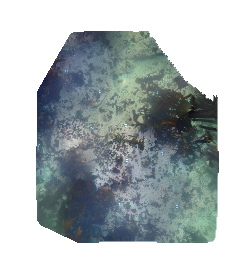
However, working underwater also presents several challenges. Water turbidity, for example, affects image quality by influencing light absorption and altering colors. Motion is another critical factor: a diver moving too quickly or the presence of moving organisms, such as fish or vegetation, can cause image blur.
For this reason, many studies focus on evaluating the precision and accuracy of photogrammetry-derived models. Through empirical approaches, researchers aim to quantify measurement errors, assess reliability over time, and continuously improve the quality of the reconstructions.
Since movement can compromise data analysis, researchers often prefer to work in relatively stable environments. Kelp forests, for instance, are not among the most suitable settings due to their constant motion. However, within them there are often crevices and microhabitats rich in fauna and flora where photogrammetry can still be successfully applied. Moreover, with post-processing software, it is possible to remove unwanted elements, the so-called “noise”, and obtain high-quality models suitable for analysis.
Conclusion
Underwater photogrammetry represents a powerful and promising tool for studying underwater ecosystems such as coral reefs. It not only enables observation without interference but also opens up new possibilities for understanding and protecting these extraordinary ecosystems.
If you are interested in learning more about sampling the underwater world, consider joining the Cape RADD Marine Biology and Conservation Field Course.