Taking a closer look at one of False Bay’s overlooked endemic sharks
When people think of the sharks of South Africa, they often picture the great white, bronze whaler, or even sevengill shark. Not many realize that beneath the kelp forest, there are several smaller shark species that belong to the Haploblepharus and Poroderma genera. These include the puffadder shyshark (Haploblepharus edwardsii), dark shyshark (Haploblepharus pictus), pyjama catshark (Poroderma africanum), and leopard catshark (Poroderma pantherinum). These endemic sharks are extremely charismatic and a fun find for scuba divers, snorkelers, or anyone who enjoys the waters of the Western Cape.
The leopard catshark is a small, bottom-dwelling, nocturnal shark species endemic to the Western Cape of South Africa. Although it is a rare find for most visitors, it is a striking species that plays an important role in the local marine environment and serves as a reminder of South Africa’s incredible biodiversity.
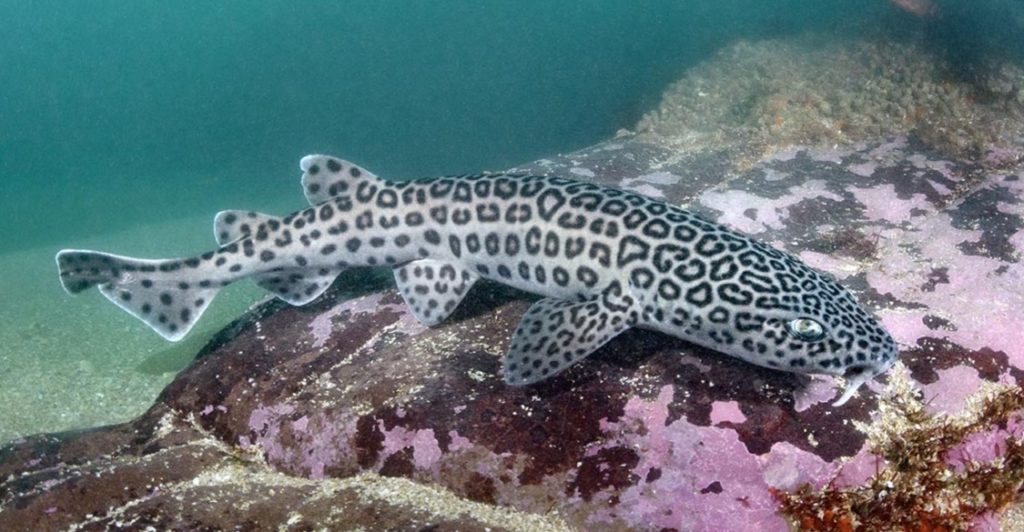
Leopard Catshark: Poroderma pantherinum by Andy Murch
Physical Description
The leopard catshark is characterized by its leopard-like pattern of horizontal rows of dark spots, rings, or lines on a gray background. It is often confused with the pyjama catshark, which has solid dark lines down its body. Patterns and coloration vary among individuals, making each shark visually unique.
Similar to other catsharks, the leopard catshark has a flattened head and blunt snout. They also have a long barbel that protrudes from each nostril. The leopard catshark differs from other catsharks in that it lacks a groove connecting the mouth to the nostrils.
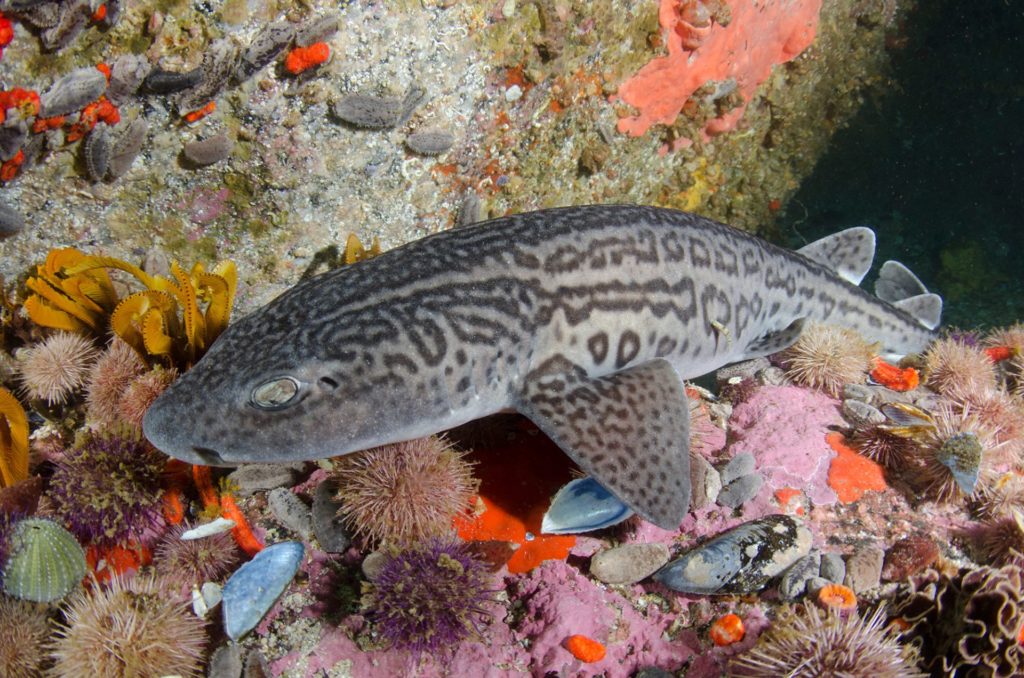
Diving with endemic catsharks in South Africa by Big Fish Expeditions
Quick Facts
| Scientific Name | Poroderma pantherinum |
| Common Name | Leopard Catshark |
| Family | Scyliorhinidae (catsharks) |
| Maximum length | Approximately 80 cm |
| Distribution | Endemic to South Africa’s Western Cape |
| Diet | Feeds at night on small, bottom-dwelling fish, crustaceans, cephalopods, etc. |
| Reproduction | Egg-laying (oviparous) |
Why is the Leopard Catshark Special?
Unlike larger pelagic sharks, the leopard catshark spends most of its life near the seafloor, where it relies heavily on camouflage to both avoid predators and hunt prey. Its unique position in the marine ecosystem makes it a good indicator species of the health of coastal reefs, as environmental changes can drastically affect its ability to hide from predators and capture prey.
Endemism
What makes the leopard catshark truly remarkable is its extremely limited geographic range. The species occurs only along portions of the southwestern and southern coasts of the Western Cape in South Africa. False Bay is one of its most important habitats, supporting a significant portion of the species’ population.
Endemism is the ecological state of a species or organism being native to and found only within a strictly limited geographic range. Endemic species are particularly important for conservation because their entire global populations occur within relatively small geographic ranges. Unlike species with broad global geographic distributions that can easily adapt to new habitats, endemic species have limited opportunities if environmental conditions deteriorate.
The limited distribution of leopard catsharks means that localized threats such as habitat degradation, pollution, overfishing, climate-driven ecosystem changes, and increased human activity can have population-level consequences. Marine Protected Areas (MPAs) and no-take zones in False Bay contribute directly to the long-term survival and protection of leopard catsharks and the many other endemic species of the Western Cape.
Leopard Catshark Habitat and Behavior
Leopard catsharks inhabit shallow coastal waters, from the intertidal zone to depths of up to 100 meters. They are most commonly observed on the rocky reefs of kelp forests. These habitats provide shelter, an abundant food supply, and suitable conditions for successful reproduction.
During the day, leopard catsharks often rest beneath kelp canopies, tucked into rock crevices or on sandy patches near reefs. Their spotted pattern blends in with the surrounding substrate incredibly well, hiding them from both predator and prey.
Once the sun sets, they begin to emerge from their rocky hiding spots and become more active. Using highly sensitive olfactory organs and electroreceptors, they forage along the seafloor and locate prey hidden beneath rocks, algae, or sediment.
One unique adaptation of shysharks and catsharks is the distinct defense behavior often referred to as the “donut”. When threatened, the shark will curl its body into a tight ring, tucking its fins and folding its head towards its tail. In this position, vulnerable areas such as the head and gills are more protected. This position also creates a difficult shape for predators to grasp or swallow. This behavior is particularly advantageous in crowded reef environments where escape may be limited.
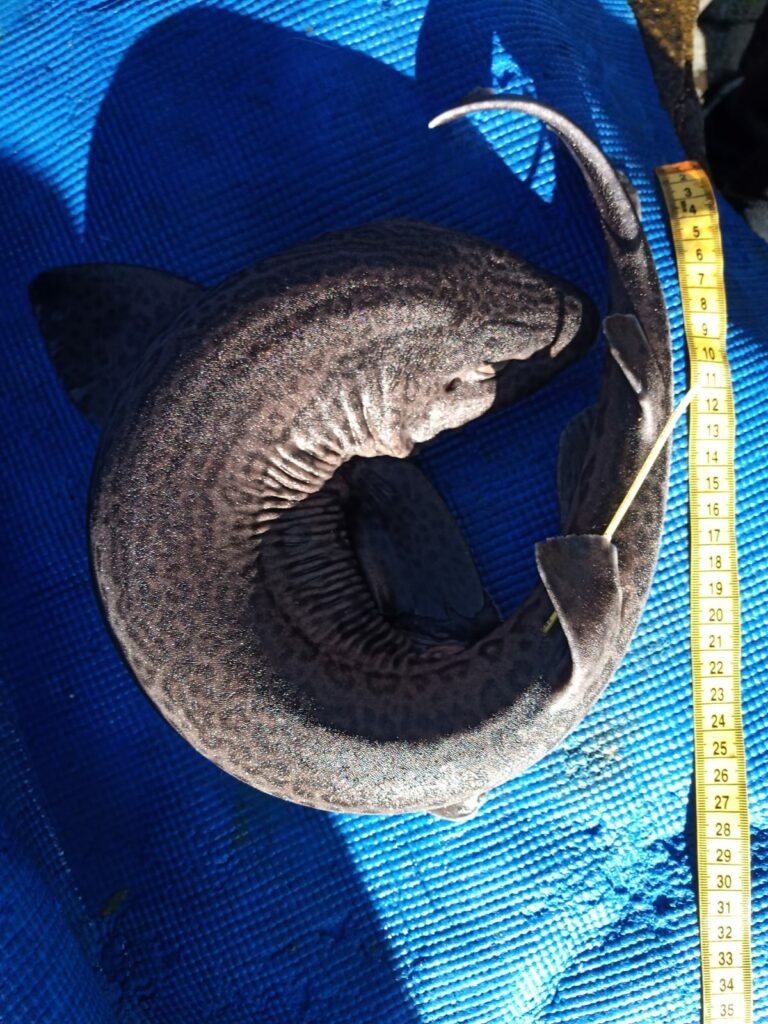
A leopard catshark curled into a defense “donut” by Marine Dynamics Academy
Reproduction
For leopard catsharks, reproduction occurs through oviparity (egg laying). Females produce tough, protective egg cases, often referred to as “mermaid purses”, that often attach to algae, kelp, rocky substrates, etc. During laying, the female twists her body to ensure the long tendrils on either end of the egg are secured to the chosen substrate. Once laid, embryos develop inside these cases for several months before hatching as independent juvenile sharks.
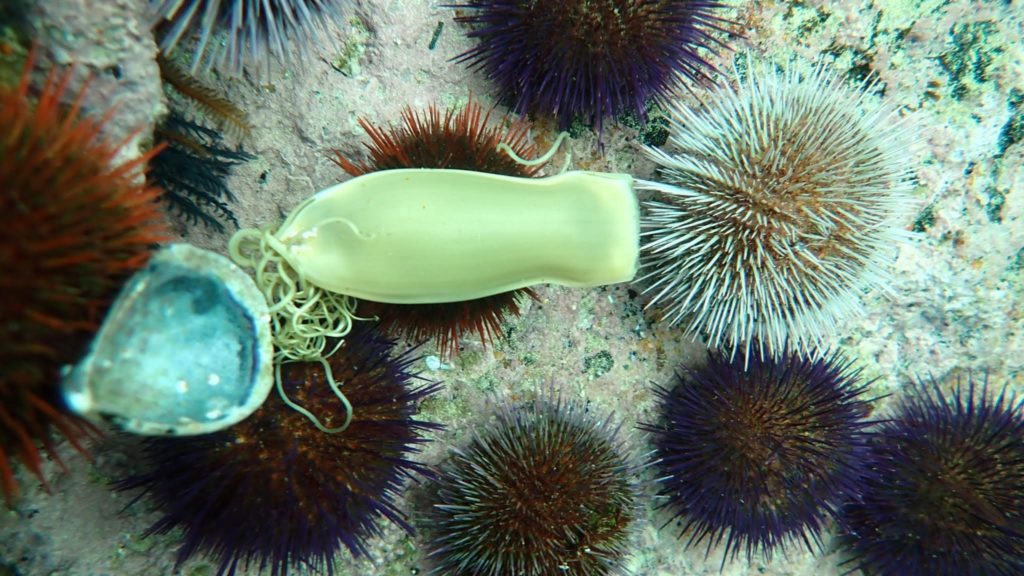
Leopard catshark egg casing used by a Cape urchin (Parechinus angulosus) for protection and food, by Cape RADD
Challenges, Research, and Conservation
Although they are one of the primary shark species in False Bay, many aspects of the leopard catshark’s ecology remain poorly understood. Ongoing research focuses on mapping habitats, understanding movement patterns, estimating population size, and identifying important feeding and reproductive areas. Researchers at Cape RADD use techniques such as underwater surveys, baited remote underwater video systems (BRUVS), and photo-identification through FinSpotter’s identification software to gather data. These efforts help identify critical habitats, monitor population trends, and guide conservation strategies, including the management of marine protected areas.
If you are interested in getting involved with shyshark and catshark research, Cape RADD conducts Research Expeditions and Citizen Science Snorkel trips that directly contribute to the growing database of knowledge on the Western Cape’s endemic shark species. Community engagement and collaboration are crucial for raising public awareness about the importance of sharks and establishing long-term sustainability and effective conservation. Cape RADD aims to preserve healthy populations of shysharks and catsharks, as well as their habitats.
References
- “Leopard Catshark: Poroderma pantherinum.” sharks and rays, https://www.sharksandrays.com/leopard-catshark/. Accessed 22 July 2026.
- “ORI Fish Fact Sheet – Leopard Catshark.” SAAMBR, https://saambr.org.za/wp-content/uploads/2023/03/ORI-Fish-Fact-Sheet-Leopard-Catshark.pdf. Accessed 22 July 2026.
- “Threats to Sharks.” Shark Info, Shark Spotters, https://sharkspotters.org.za/education/shark-info/threats-to-sharks/. Accessed 22 July 2026.
0 Comments